Michigan Tax Preparation Checklist
What to gather and check before filing your Michigan return for tax year 2026 (filed in 2027).
01Personal information
- Social Security numbers (or ITINs) for you, your spouse, and every dependent
- Photo ID and dates of birth (age and birth year affect some retirement rules)
- Last year's federal and Michigan returns
- Bank routing and account numbers for refunds or payments
- Move-in and move-out dates if you were a part-year Michigan resident (the exemption is prorated)
02Income documents
- W-2s from every employer
- 1099-NEC, 1099-MISC, and 1099-K, plus records of self-employment or gig income
- 1099-INT and 1099-DIV for interest and dividends
- 1099-B and records of stock, crypto, or property sales; 1099-S for real estate sales
- 1099-R for pensions, IRAs, and annuities
- 1099-G for unemployment and state refunds
- W-2G for gambling winnings
- SSA-1099 for Social Security (Michigan does not tax it)
- 1099-SA and 5498-SA for HSA activity; 1099-Q for education accounts
- 1099-C for canceled debt
- Rental income and expense records, and K-1s from partnerships, S corporations, or trusts
- Form 1095-A (marketplace health coverage), if you had it
03Deduction and credit paperwork
- Mortgage interest (1098) and property tax bills
- Charitable donation receipts
- Medical expense records, if you itemize federally
- Student loan interest (1098-E) and tuition (1098-T)
- Child care provider names, addresses, and tax ID numbers
- IRA, 401(k), and HSA contribution records
- New for 2026: Michigan allows deductions for qualified tips and qualified overtime pay for tax years 2026 through 2028, matching the federal deductions. Ask your employer for year-end breakdowns, and keep your own records.
04Michigan credits to check
- Homestead Property Tax Credit (MI-1040CR): for homeowners and renters whose household resources and property values fall under annual limits (for 2025: $71,500 in household resources and $165,400 taxable value; 2026 limits will be in Treasury's forms). You must have lived in Michigan at least six months. Renters need landlord and lease details. You can claim it without filing a return, and up to four years back.
- Michigan Earned Income Tax Credit: 30% of your federal EITC.
- Home Heating Credit: for lower-income households with heating costs.
- Special exemptions: for people who are disabled, qualified disabled veterans, and stillbirth (certificate required).
05Retirement income
- Social Security is not taxed by Michigan, and military pensions are exempt.
- Pension and retirement subtraction: for 2026 the phase-in is complete, and eligible taxpayers of any birth year may subtract up to 100% of the limit: $67,610 single or married filing separately, $135,220 joint (per Treasury's 2026 bulletin). Confirm the figures in the 2026 MI-1040 instructions.
- Public pensions now count toward the same cap, except for people born before 1946, who keep an unlimited public pension subtraction.
- Governmental 457 deferred compensation generally does not qualify.
- Taxpayers born after 1952 and age 67 or older may claim both the standard deduction and the Social Security deduction for 2026 through 2028.
- Gather 1099-Rs and pension statements showing the plan type, since it affects eligibility.
06City income tax
- About two dozen Michigan cities levy income tax (Detroit, Grand Rapids, Lansing, Flint, and Saginaw among them)
- Check whether you live or work in one, and keep city withholding from your W-2s
- City returns and estimated payments are separate from your state return, with their own forms and due dates
07Estimated payments and withholding
- Records of 2026 estimated payments (MI-1040ES) if you're self-employed or have income without withholding
- Payments made with an extension request, or overpayments applied from last year
- Your withholding totals, to decide whether to adjust your W-4 and MI-W4
08Choose how to file
- Michigan Treasury eServices: Treasury's online portal for filing, checking refunds, and paying. It replaced older individual income tax systems in late 2025.
- Tax software or a paid preparer: most Michigan taxpayers e-file.
- Free help: VITA and similar volunteer sites assist many lower-income filers and seniors.
- Paper: possible but slower. Use the mailing address in the current MI-1040 instructions.
09Key dates
- Jan. 15, 2027: fourth 2026 estimated payment. You can skip it if you file your 2026 return by Feb. 1, 2027 and pay the full balance.
- Late January: W-2s and most 1099s should arrive
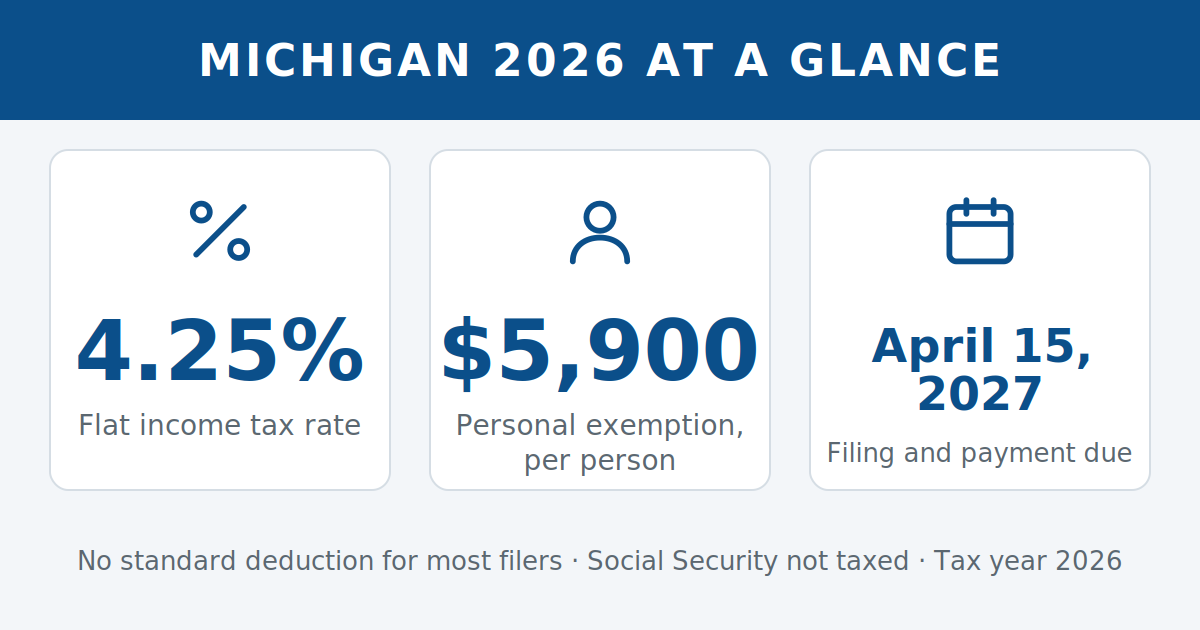
- April 15, 2027: return and payment due
- 2027 estimates: normally April 15, June 15, Sept. 15, and Jan. 15, 2028. Confirm on the 2027 MI-1040ES.
- An extension to file is not an extension to pay. Pay what you expect to owe by April 15.
10Before you submit
- Match names and Social Security numbers to your cards exactly
- Attach all required schedules and federal return information
- Double-check routing and account numbers
- Remember that state refunds and the homestead credit may be taxable on your federal return in some cases
- Save a complete copy of your return and supporting documents
11After you file
- Track your refund in Michigan Treasury eServices
- Respond quickly to Treasury letters, since identity, EITC, and homestead credit reviews can delay refunds
- Keep records for at least four years
General information, not tax advice. Rates, exemptions, and limits change, so confirm current figures at michigan.gov/incometax or with a qualified tax professional. Last reviewed October 2026.